| |
Insect Identifier |
| |
Ants |
| |
Acrobat Ant |
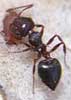 |
Several species of small to medium-sized ants are occasional pests in and around the home. One of these is named the acrobat ant because of the way the worker ants carry their abdomens above the rest of the body as if they were performing a balancing act. Acrobat ants are slightly longer than 1/8th inch. They vary in color from yellowish brown to dark brown, and the heart-shaped abdomen is usually darker than the rest of the body. Magnification is required to see a pair of spines on the back edge of the middle section of the body that helps identify this ant from other species. The habit of the workers to carry their abdomens in the air when they are disturbed is probably the best way to identify this species. |
| |
Argentine Ant |
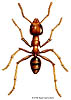 |
These pests are most predominant in the southern U.S. with heavy concentrations in California. Nests can reach extreme proportions and can be found near a wood source that has an adequate water and food supply. Argentine ants can persist in a variety of climates. Females measure from one-twelfth of an inch to one-eighth inch. They are dark brown in color and live in a strictly defined caste system. The queen measures one-sixth of an inch to one-quarter inch and is brown in color. Argentine ants prefer sweet foods such as sugars, syrups, fruit and fruit juices. |
| |
Carpenter Ant |
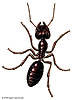 |
Carpenter ants get their name from the damage they cause. They excavate large, smooth galleries in wood which creates a sandpaper-finished look, hence the name. These dark black-brown ants thrive on both coasts of the U.S. but are found throughout the country. They typically reside in or around the home and are most active in warmer seasons and climates. Workers vary in length from one-quarter inch to more than three-eighths inch in length. These ants also have large mandibles and are aggressive biters. On warm spring days, their presence is known when swarms of large-winged ants hover near windows or when wingless ants forage through food pantries. |
| |
Fire Ants |
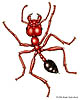 |
Named appropriately for their red hue and painful sting, fire ants are difficult to control because of their large colony size and reproductive capabilities. The imported red fire ant is thriving in the southeastern U.S. from Virginia to Texas, while the southern fire ant inhabits the Gulf Cost region from California to South Carolina. The reddish color is predominant on their head, thorax and abdomen. Workers vary in size from one-sixteenth of an inch to one-quarter inch. Southern fire ant mounds are flat and irregular. Imported red fire ants build much bigger and more rounded mounds, which can measure over 18 inches high. |
| |
Pavement Ants |
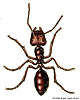 |
This ant gets its name from commonly locating itself and its nests in or under cracks in pavement. Their bodies are light brown to black with pale legs and antennae and they measure approximately one-eighth an inch. The antennae have 12 segments, a stinger is present and the thorax has a pair of small spines on the upper back. Colonies are moderately large and reproductives usually emerge in June and July. Pavement ants are known to nest in walls, in insulation, under floors, in masonry walls of a foundation, and near heat sources in the winter. |
| |
|
| |
Confused Flour Beetle |
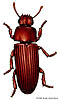 |
This pest is cousin to the red flour beetle and is particularly destructive to flour. They can cause flour to turn gray, mold, and become smelly and can change its overall taste. They live primarily in the northern United States, yet confused flour beetles live wherever humans keep food -- mills, processing plants, warehouses, grocery stores and homes. They are reddish-brown and are very small, measuring only 3.5 mm in length. Its compactness gives them the advantage to invade even sealed food containers. |
| |
|
| |
Centipede |
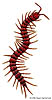 |
These brownish elongated pests have one pair of legs per body segment. Legs can number between 10 and 100. Centipedes can measure from one to six inches in length. Centipedes are found throughout the United States, usually outdoors in dark damp areas. Yet, house centipedes, a yellow-gray species, dwell indoors in moist areas such as cellars, bathrooms and damp closets. |
| |
|
| |
Cockroaches |
| |
|
| |
German Cockroach |
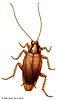 |
The German cockroach can be found in kitchens and bathrooms of homes and apartments, grocery stores, food processing plants, restaurants and other structures around the world. Where there's a water source, there's probably a German cockroach near by. They are dark brown in color with two dark longitudinal streaks on the pronotrum. Females are slightly darker than males and they both typically measure approximately five-eighths inch. These winged pests favor humid conditions and can breed year-round. |
| |
Oriental Cockroach |
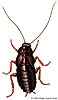 |
Oriental cockroaches are residents of the darkest and dirtiest of places. They harbor in sewers and make their way in food packaging and air-ducts. You can spot them in dark, damp basements, under laundry baskets, and near garbage holding areas. It's less wary and slower than most other species, they measure approximately one inch in length and are extremely dark brown in color. Oriental cockroaches are sometimes referred to as the black beetle. |
| |
|
| |
House Cricket |
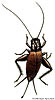 |
This pest, a relative to the grasshopper, is climate and temperature sensitive. Crickets are much more active in warmer seasons and areas. They're attracted to warm, dry kitchens, fireplaces and utility areas. Known for their musical ability and chirping song, crickets are fond of liquids, including beer and vinegar. Crickets, which typically measure three-quarters of an inch in size, are yellowish-brown in color and have three dark brown bands about the head and have long, thin antennae. They're also equipped with strong hind legs for hopping and composing sound via vibration. |
| |
|
| |
Earwigs |
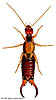 |
There are approximately 1,100 earwig species in the world with 22 in the U.S. These nocturnal pests are brownish-black, have a narrow, elongated body that ranges from a quarter-inch to one inch in length. Their antennae have multiple segments. Earwigs reside in dark moist cracks beneath stones, wood and debris. |
| |
|
| |
Flea |
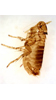 |
This small, wingless insect was responsible for transmission of the devastating bubonic plague of the Middle Ages. They're found throughout the world, with the cat flea being the biggest concern for humans and pets. Cat fleas are approximately one-eighth inch in length and are brownish-black to black. They have a body that is flattened side-to-side which enables them to move swiftly through hair and feathers. The body is covered with spines that project backward and they have several segments and three pairs of legs, which contributes to the flea's excellent jumping ability. |
| |
|
| |
House Fly |
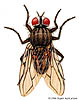 |
The typical house fly is gray with thin, transparent wings. An adult fly measures about one-eighth inch to one-quarter inch. Females are usually larger than males. Sex can be determined by examining the space between the eyes. Female spacing is almost twice as broad as a male's. Throughout their life stages, (egg, larvae, pupae, to adult) the house fly takes on various shapes. In the larvae or maggot stage, flies resemble greasy white worms. House flies are attracted to a variety of warm, moist substances from animal feces to human food and garbage. |
| |
|
| |
Mosquito |
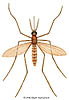 |
Throughout their development, mosquitoes undergo complete metamorphosis via four stages, egg, larvae, pupa and adult. Mosquitoes are found throughout the world with heavy concentrations in areas with wet, humid climates. They are blood-sucking pests, can transmit serious diseases, such as malaria, and are a continuous nuisance to humans. Larvae and pupae must have a water source for survival. Typical breeding grounds include ponded streams, lake edges, swamps and flowing streams. Mosquitoes have tremendous potential for reproduction. |
| |
|
| |
Clothes Moth |
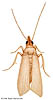 |
This pest earns its name from the silk webbing left behind when the larvae are feeding on cloth materials. The most common clothes moth in the U.S., they measure one half inch and are golden-brown with red-gold hairs on the head. The larvae, which cause the destruction, have darker antennae. They feed on a diet of soiled materials including clothes, carpets, furniture, wool and animal hair. |
| |
|
| |
Scorpion |
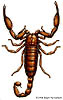 |
The venom of most scorpions is no more poisonous than a wasp sting. Yet, the Ewing, the most dangerous scorpion in the U.S., (found in southern Arizona, Texas, California and New Mexico) can be harmful, even deadly. Common striped scorpions have two broad, dark longitudinal bands on the dorsal side of their abdomen. They have yellowish-brown appendages, eight legs, two to twelve eyes, and a large pair of pinchers. Males measure approximately 2.6 inches in length with females slightly smaller at 2.3 inches long. These pests are attracted to moisture and have a preference for homes constructed out of masonry brick. They find the space behind the veneer ideal after they enter. This provides them with entry into the home. |
| |
|
| |
Silverfish |
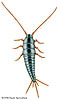 |
These small, silver-scaled pests can be found throughout the U.S. Shaped more like a carrot than a fish, these creatures have two long antennae that protrude from the front while three, bristly antennae-like appendages project from the rear. Average length is about one half inch. Silverfish seek dark, warm, moist areas such as attics, closets, baseboards and bathrooms. They feed on drywall, protein-based sources such as flour, starch and cereal. They're most active at night and scurry quickly when discovered. Signs of silverfish damage include uneven holes in paper and small yellow stains on fabric. |
| |
|
| |
Sow bug |
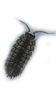 |
This pest, actually the only crustacean that's completely adapted to life on land, enjoys worldwide distribution and thrives in moist accommodations, typically in basements, first floors of houses and under vegetable debris of all kinds. Sow bugs rarely exceed three-fourths of an inch in length and have an oval body shape that is flat and hollow underneath. Unlike pill bugs, sow bugs have two distinctive tail-like appendages and they cannot roll up into a ball. Activity may occur year-round in artificially heated buildings, such as greenhouses, but sow bugs are typically dormant in the winter months. |
| |
|
| |
Spiders |
| |
|
| |
House Spider |
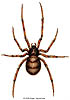 |
This pest is responsible for the most cases of reported indoor spider bites in the U.S. They are widely distributed throughout the country, yet it is not known where the house spider originates. They enter homes through exterior cracks and holes and can live inside wall voids. This pest selects web sites at random and when a web does not produce prey, it is abandoned. House spiders are susceptible to moisture, which ultimately leads to a high mortality. Their body is approximately three-eighths of an inch in length and is brown in color. |
| |
Black Widow Spider |
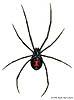 |
Maybe the most infamous of all spiders, this creature earned its name from the popular belief that a female eats the male after mating, an act that rarely occurs. Males are half the size of females. The overall length of a female, including her legs, measures about 1 1/2 inches to 1 3/8 inch. The female's abdomen is black on the under side with a red hourglass shaped marking. Males do not have such markings. These spiders spin irregular webs and hang in an inverted position to catch prey. Only a female black widow bite should merit concern. |
| |
|
| |
Termites |
| |
|
| |
Coptotermes, alate |
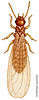 |
Also known as swarmers, these winged Formosan termites are larger than other native subterranean termites. They measure about one half inch and their bodies are pale yellow-brown in color. The wings are also pale in color and are densely covered with tiny hairs. Alates or swarmers participate in a process known as swarming on warm humid evenings in the early spring. This behavior ensures the establishment of new colonies. They are attracted to light during the swarm. |
| |
Coptotermes, soldier |
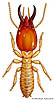 |
Formosan soldiers are distinctive in that they have an oval-shaped head rather than an elongated one like other native subterraneans. Formosans are much more aggressive than other native termites. They can be found some 500 feet from the colony. Their sole purpose in life, to defend the colony. |
| |
Heterotermes, soldier |
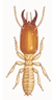 |
Heterotermes soldiers have rectangular shaped heads and the soldier's length is one and a half times its width. Soldiers also have mandibles and a fontanelle or frontal gland pore. |
| |
Reticulitermes, alate |
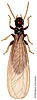 |
This swarmer measures three-eighths of an inch, which includes its wings. Their bodies are dark brown and have dark brownish-gray wings with a few visible hairs. The front wings are slightly larger than the hind wings. |
| |
Reticulitermes, nymph |
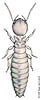 |
Nymphs will subsequently transform into workers, soldiers or winged reproductives. Nymphs, along with workers, also tend and care for the young. |
| |
Reticulitermes, secondary |
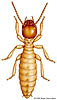 |
Secondaries play a critical role in the maintenance and rapid increase of a colony's population and help expand the foraging territory of existing colonies by creating secondary colonies. They vary in appearance, yet are larger than nymphs or workers and are often times darker. |
| |
Reticulitermes, soldier |
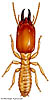 |
These termites are yellowish-brown and have rectangular shaped heads that are wider in the front for defense purposes. The head is equipped with two very large jaws or mandibles. Soldiers also have a fontanelle or frontal gland pore. Their head length is nearly two times their width. |
| |
Reticulitermes, worker |
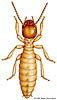 |
Workers are blind, sterile and wingless. Yet, they are the most encountered and most destructive. They are soft-bodied, creamy-white in color and have hard, powerful mouth-parts that adapt for chewing. Workers measure one-quarter inch and are responsible for most of the labor of the colony and must care for the young. |
| |
|
| |
American Dog Tick |
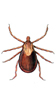 |
You can find these reddish-brown pests throughout the world but they're not limited to domestic dogs as their host. An unengorged adult measures one-eighth inch but can enlarge to one half inch when filled with blood. Once engorged, the body changes to a gray-blue color. Dog ticks can transmit deadly diseases to humans including tick paralysis, Rocky Mountain spotted fever and tularemia. |
| |
|
| |
Yellow Jackets |
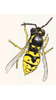 |
Known and feared by many as a wasp, these pests are found in Canada and in approximately 38 states in the U.S. They have shiny yellow and black bodies with a stinger located at the end of the body which can measure up to three-quarter inch. They live in organized colonies within carefully constructed multi-combed "paper" nests found underground. Yellow jackets are attracted to sweet food and strong scents. |
|
 |
 |
|
|
Insist that Only a
Certified Applicator do your Termite Inspection. You deserve the best!
|
Step by Step Pest Services - Believes
that you deserve only the most highly qualified personnel to inspect the
single most expensive purchase you will likely ever make. We do NOT allow
Apprentice or Licensed Technicians to perform the most important job we do.
|
|
2008, December
|
|
Tip of the month:
|
Winter's here and so are the Rodents -
Exclusion is the key. Look around your home for any openings wider than a
dime. Check weep holes, windows, doors, freeze boards and don't forget the
vent panels in the attic. Seal them up, seal out rodents and enjoy savings
on your energy bills too!
|